Norovirus Risk Perspective
Norovirus causes an estimated 19–21 million illnesses in the US each year and about 900 deaths annually, mostly among adults aged 65 and older, according to CDC — the highest annual case volume of any virus in this comparison, yet among the least severe on a per-case basis.
Written and researched by Andy Wilcox · Last reviewed: August 2026
The Numbers
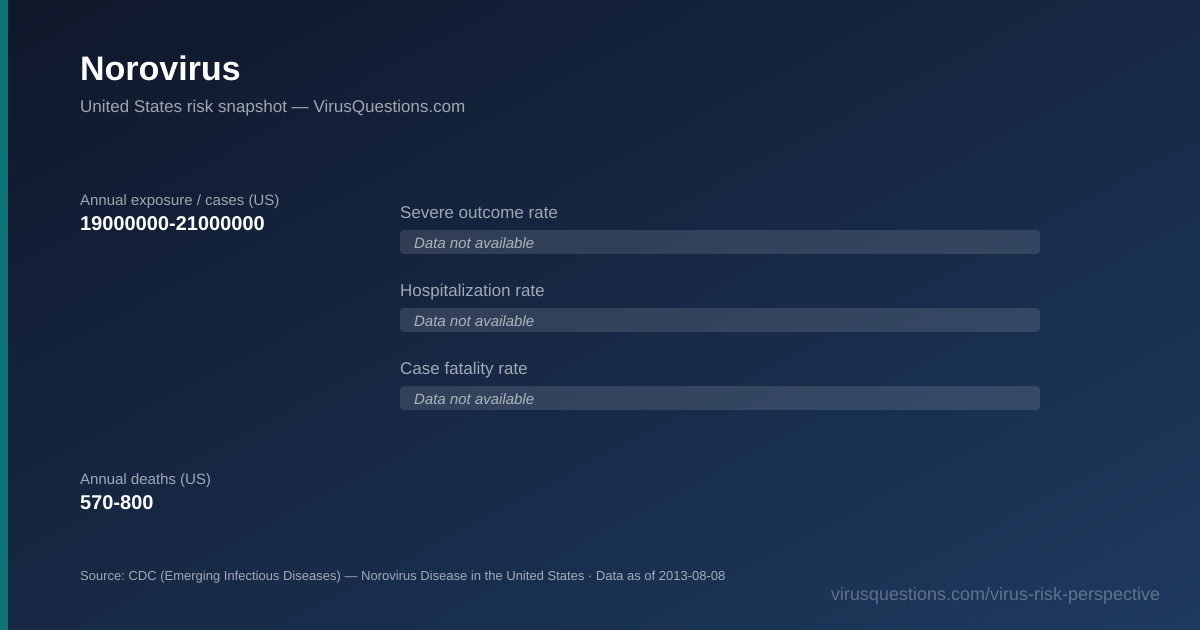
Every published figure, and where it came from
These are the figures Norovirus is actually reported with, each shown beside the source that published it and the date it was current. They are read from a single dataset shared across this network, so a correction made once reaches every page that cites it.
| Metric | Figure | Source | As of |
|---|---|---|---|
| Annual exposure / cases | 19,000,000–21,000,000 | CDC — Norovirus Facts and Stats primary source | 2024-05-08 |
| Severe outcome rate | Data not available | CDC — Norovirus Facts and Stats primary source | 2024-05-08 |
| Hospitalization rate | Data not available | CDC — Norovirus Facts and Stats primary source | 2024-05-08 |
| Case fatality rate | Data not available | CDC — Norovirus Facts and Stats primary source | 2024-05-08 |
| Annual deaths | 900 | CDC — Norovirus Facts and Stats primary source | 2024-05-08 |
CDC's current published US burden estimate (Norovirus Facts and Stats, updated 2024-05-08): about 900 deaths a year, mostly among adults aged 65 and older, and 19-21 million illnesses. This supersedes the older 570-800 death estimate from CDC's 2013 Emerging Infectious Diseases synthesis. Page re-read 2026-09-15: still dated May 8, 2024 with the same figures (it also gives 109,000 hospitalizations and 465,000 emergency-department visits a year), so the 2024-05-08 date stands as the figure's own date. Norovirus is not individually case-reportable, so the case-fatality and hospitalization rates are left UNAVAILABLE rather than derived as crude ratios of two modelled estimates.
What is not measured, and why that matters
3 of these five metrics have no published figure for Norovirus: severe outcome rate, hospitalization rate, case fatality rate. Rather than estimate them, borrow a number from a different population, or present one study's result as a general rate, they are left empty.
This is worth understanding before comparing Norovirus to anything else: an empty figure is not a low one. It means nobody has published the measurement. Read as zero, it would make the least-studied diseases look like the safest.
Beyond the United States
CDC's Yellow Book (2026 edition, page updated April 23, 2025) reports that globally norovirus causes approximately 18% of acute gastroenteritis cases and is responsible for tens of thousands of deaths annually, without a precise count. The two populated cells are therefore the modelled estimates from Bartsch et al. 2016 (Tier 2): ~685 million cases and ~212,489 deaths a year. CDC's Norovirus Facts and Stats page (May 8, 2024) cites the same 685 million cases and about 50,000 child deaths. Re-read 2026-09-15: no newer global estimate has been published by CDC or WHO, so the 2016 figures and their dates stand.
Compare Norovirus against 14 other viruses →
How these sources are tiered, and why a calculated figure is never rated above its weakest input →
Figures this site tracks beyond the shared dataset
- Hospitalizations (US): ~109,000
- Emergency department visits (US): ~465,000
Source: CDC — Norovirus Facts and Stats · Data as of 2024-05-08. These two are not among the five metrics the cross-virus dataset holds, so they are reported here rather than in the table above.
Case counts and mortality data on this page are sourced directly from CDC as cited above. This is statistical and educational information, not medical advice or a risk assessment for any individual. Check the "data as of" date and linked source for the latest numbers.
Common, but rarely fatal — how to read these numbers
Norovirus sits at an unusual corner of the risk map: enormous incidence paired with a low per-case fatality rate. With 19–21 million illnesses but roughly 900 deaths a year (CDC), the crude case-fatality rate is on the order of a few thousandths of a percent — far below the severe viral hemorrhagic fevers or hantavirus in this comparison, whose case counts are a tiny fraction of norovirus's but whose fatality rates run into the tens of percent.
Most people recover from norovirus within 1 to 3 days, according to CDC, and the illness is self-limiting. The danger is not the virus itself but dehydration from repeated vomiting and diarrhea — which is why the deaths that do occur are concentrated in the groups least able to tolerate fluid loss: adults aged 65 and older, young children, and people with other medical conditions. There is no vaccine and no specific antiviral for norovirus, so prevention and prompt rehydration are the only tools.
That combination — very common, occasionally serious, never trivial for the vulnerable — is the honest way to hold the risk. A low per-case fatality rate across tens of millions of illnesses still adds up to about 900 deaths and roughly 109,000 hospitalizations in the US every year, per CDC.
Compare norovirus against 14 other viruses on the Virus Risk Perspective tool →
Sources & References
- Centers for Disease Control and Prevention. Norovirus Facts and Stats. cdc.gov/norovirus/data-research (updated May 8, 2024).
- Centers for Disease Control and Prevention. About Norovirus. cdc.gov/norovirus/about.